ActiveCampaign Ecommerce Automation 2026: Complete Guide

Still manually emailing customers like it’s 2012? 😅 Relax, this 2026 guide to ActiveCampaign Ecommerce Automation shows you how to sell on autopilot while you sip coffee and pretend you ‘worked all day.
⚡ Quick Take
ActiveCampaign ecommerce automation in 2026 lets online stores trigger personalized, behavior-based customer journeys completely on autopilot, including abandoned cart recovery, post-purchase upsells, win-back campaigns, product recommendations, and multi-channel flows across email, SMS, and WhatsApp.
It is powered by Active Intelligence, an AI engine with 25+ specialized agents that builds and runs campaigns from plain-language goals.
Plans start at $15/month for 1,000 contacts (annual billing).
A 14-day free trial is available with full feature access. No credit card required.
Why I’m Writing This
ActiveCampaign’s ecommerce automation was not even on my radar. Early this month, on a Saturday, I was at a coffee shop, latte in hand, half-working and half-watching the street outside, when my friend Paloma sent me a voice note.
“Mia, I lost three customers this week. They added to the cart, never checked out, and I found out on Friday. Friday.”
I put the coffee down slowly. Three customers. Gone. In silence. For an entire week.
Paloma runs a small online accessories store. She’s brilliant at sourcing products and genuinely terrible at follow-up. If you told her to manually send 40 cart reminder emails, she’d sooner shut the shop.
I’ve been there myself, freelancing for ecommerce clients who had elaborate marketing plans that lived in Google Docs and died in Google Docs.
So that same Saturday evening, I got her on a video call. We opened ActiveCampaign together.
Not the basic stuff. The real deal: the automation builder, the ecommerce integrations, the AI features they’d been quietly shipping all year.
By Sunday evening, Paloma’s store had a full abandoned cart sequence running, a welcome flow for new subscribers, and a post-purchase upsell email firing automatically 48 hours after every order.
She didn’t touch another follow-up email again after that weekend. The platform took over.
That’s when I knew I had to write this guide.
What Is ActiveCampaign Ecommerce Automation, Really?

Let’s clear something up first.
Because a lot of store owners hear “email automation” and picture scheduled newsletters going out every Tuesday.
Non, mon ami. That’s not what we’re talking about.
ActiveCampaign ecommerce automation is the ability to trigger personalized, behavior-based customer journeys that respond in real time to what shoppers actually do on your store.
Browse a product three times without buying? ✔️ Trigger.
Buy once and disappear for four months? ✔️ Trigger.
Add to cart, get distracted by a cat video, and bounce? ✔️ Big trigger energy right there.
The platform serves over 180,000 businesses across 170+ countries.
It integrates natively with Shopify, WooCommerce, BigCommerce, Magento, and Square, and connects to 1,000+ other tools through its integration library.
You’re almost certainly already using something it talks to.
What separates ActiveCampaign from platforms like Mailchimp or even Klaviyo is the depth of automation logic: 135+ triggers and actions, 500+ pre-built automation recipes, and, as of 2025, an AI layer that changes what automation even means for a growing store.
This platform is not for people who want to send a weekly newsletter. It’s for store owners who want their marketing to run while they sleep. Or sip Piña Colada on a Saturday. Same thing.
👉 Try ActiveCampaign free for 14 days — no credit card, full access.
Active Intelligence: The AI Brain Running the Show in 2026
Here’s where everything changed. And I mean everything.
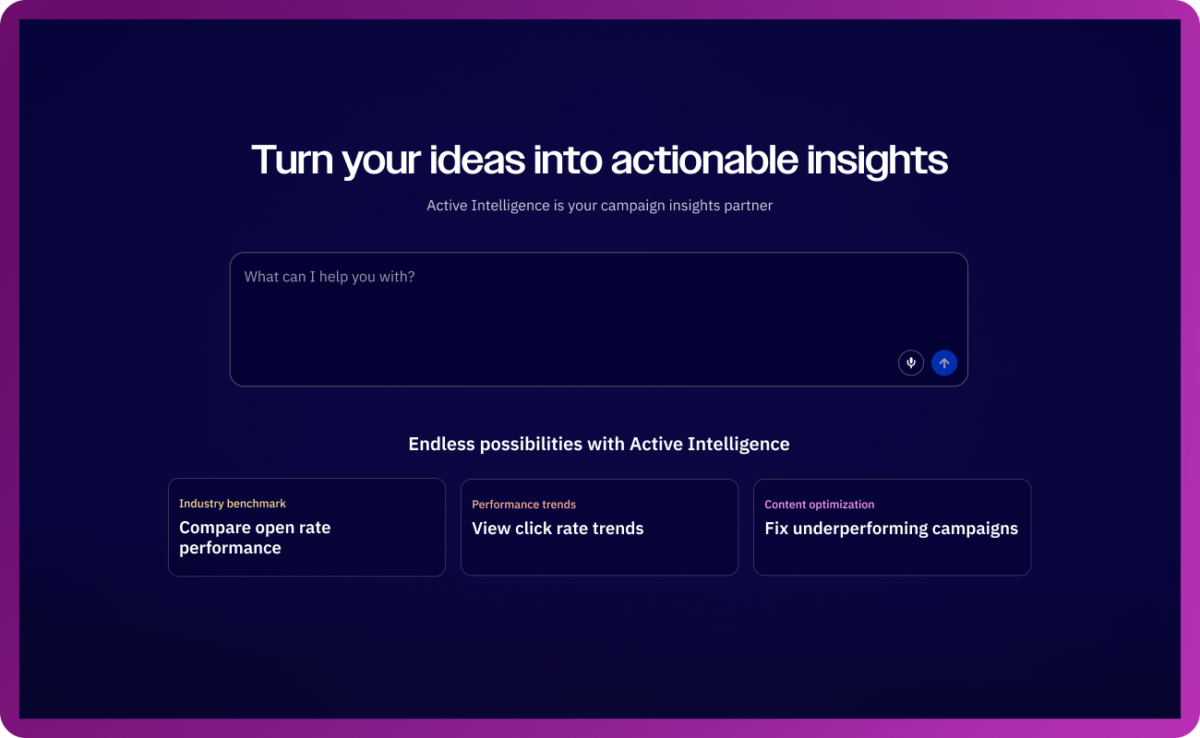
In May 2025, ActiveCampaign launched Active Intelligence, its AI-powered autonomous marketing engine.
By October 2025, it was live across all admin accounts on every plan.
By the end of 2025, they had shipped 34+ Active Intelligence capabilities and were still rolling out more.
The difference between traditional automation and Active Intelligence is not subtle.
Old-school automation says: “When someone abandons their cart, send email #3 exactly 2 hours later.” Rigid. Static. You do all the thinking, the platform just executes.
Active Intelligence says: “Recover abandoned carts.” Full stop.
The AI then figures out the best message, the optimal send time, the right channel, whether email, SMS, or WhatsApp, the personalization angle, and the follow-up sequence.
All of it, handled by AI agents trained on billions of data points across 180,000+ businesses.
The AI Agents Worth Knowing
| Agent | What It Does |
|---|---|
| Campaigns Agent | Builds complete email campaigns from a simple text prompt — copy, subject lines, scheduling included |
| Automations Agent | Generates full multi-step workflows from plain-language goals. You describe what you want. It builds the flow. |
| Insights Agent | Analyzes campaign performance in real time and surfaces specific optimization recommendations |
| Segments Agent (Oct 2025) | Identifies your highest-value customer segments automatically, without manual data digging |
| AI Brand Kit Agent | Pulls your logo, colors, and fonts from your URL and applies them across all email templates instantly |
This is what autonomous marketing actually means.
You set the goal. The AI executes the strategy. Your team stops spending hours building workflows and starts spending time on decisions that actually require a human.
For ecommerce, this is not just a feature upgrade. It’s a competitive advantage over every store still building sequences manually.
👉 See Active Intelligence in action. Start your free trial.
5 ActiveCampaign Ecommerce Automations to Set Up First
Enough context.
Let’s get practical.
These are the five ActiveCampaign ecommerce automations that will make the most immediate difference for your store, especially if you’re starting from scratch.
1. Abandoned Cart Recovery — The Revenue You’re Already Losing 🛒

75% of online shoppers abandon their carts.
Not 10%. Not 30%. Three out of every four people who reach checkout walk away. That’s the reality of ecommerce.
The good news is that this is the most recoverable revenue in your entire business. Morrow Audio, an ActiveCampaign customer, recovered 26% of incomplete sales and $30,000 in revenue using this single automation alone.
How to set it up:

Connect your Shopify or WooCommerce store to ActiveCampaign. Go to Automations > Browse Recipes > filter by Ecommerce. Select the abandoned cart recipe. Customize the timing:
- Email 1 — 1 hour after abandonment. Simple, friendly reminder. No discount yet.
- Email 2 — 24 hours later. Add social proof: reviews, ratings, or a testimonial.
- Email 3 — 72 hours later. An optional small incentive if you want to close the deal.
With Active Intelligence running, the AI optimizes message content based on what was actually in the cart. Someone abandoning a $300 item gets a different approach than someone abandoning a $15 accessory.
✅ Best for: Every ecommerce store, every niche, every platform.
👉 Set up your abandoned cart sequence today. Try free.
2. Welcome Series for New Subscribers 👋

First impressions close sales.
When someone subscribes to your list or creates an account, you have a brief window, maybe 48 hours, to make them actually care about your brand. Most stores waste it by sending one generic “thanks for signing up” email and going quiet.
A proper welcome series runs 3 to 5 emails over the first week:
- Email 1: Who you are, what makes your brand different, and why they should care.
- Email 2: Your best-selling products with real social proof: reviews, ratings, and user photos.
- Email 3: A soft offer. Free shipping threshold, a modest discount, or a limited bundle.
This is where ActiveCampaign’s conditional content feature earns its keep.
The actual email body changes based on what each subscriber browsed before signing up. Someone who visited your hiking gear section sees different products than someone who browsed your running category. One automation. Infinite personalization.
✅ Best for: Stores with email sign-up forms, pop-ups, or lead magnets.
👉 Build a welcome series that converts. Start your free trial.
3. Post-Purchase Upsell and Cross-Sell Flow 💳

Someone just bought from you. They’re in a yes mood. Their wallet is already open. This is statistically the best moment to recommend something complementary, and most stores completely miss it.
Set up a post-purchase automation that triggers 48 hours after a confirmed order.
ActiveCampaign’s product recommendations feature analyzes each customer’s purchase history and suggests relevant items automatically. The email feels like a natural, helpful suggestion rather than a hard sell.
This flow has moved the needle for literally every ecommerce client I’ve helped set up on ActiveCampaign. It’s not glamorous. It just works.
✅ Best for: Stores with complementary products or consumable items that require repurchasing.
👉 Turn every purchase into the next one. Try ActiveCampaign free.
4. Win-Back Campaign for Lapsed Customers

Someone bought six months ago.
Then nothing. Crickets. They’re not angry. They’re just… gone. And you’ve been so busy chasing new customers that you forgot about the ones you already paid to acquire.
A win-back automation fires automatically when a customer crosses a defined inactivity threshold, say 90 or 120 days without a purchase. ActiveCampaign tracks purchase data from your store and handles the trigger logic. Your job is to write one good re-engagement email.
Keep it short. Make it personal. Give them a reason to come back. And yes, “we miss you” subject lines do outperform clever ones in most split tests. Don’t @ me.
✅ Best for: Any store with repeat-purchase potential and a customer list older than 6 months.
👉 Reactivate dormant customers automatically. Try it free.
5. Birthday and VIP Loyalty Automations 🎂

This is the one most ecommerce stores sleep on completely.
I genuinely do not understand why.
ActiveCampaign lets you trigger date-based automations from custom fields you collect.
A birthday email with a 15% off coupon that fires automatically on a customer’s birthday. A “thank you for being a VIP” email when someone hits their 5th purchase. A loyalty tier upgrade notification is sent when spending crosses a threshold.
These automations build emotional loyalty that no paid ad can replicate.
A customer who gets a birthday discount from your brand remembers it. They talk about it. That kind of retention is expensive to buy and free to automate.
✅ Best for: Stores focused on customer lifetime value and repeat purchase rates.
👉 Automate loyalty that actually keeps customers coming back.
How to Connect ActiveCampaign to Your Store (Step by Step)

This part isn’t as intimidating as it looks, even if anything involving APIs makes you want to pour a large whiskey.
✅ Connecting Shopify to ActiveCampaign is simple.
You go into ActiveCampaign → Settings → Integrations, choose Shopify, click Connect, and install the app on your Shopify store. This lets the two systems talk to each other without dealing with APIs manually.
After connecting, customer data, order history, and product information sync into ActiveCampaign, meaning you’ll see contacts, past orders, products, and future purchases inside your ActiveCampaign account.
✅ WooCommerce requires the official ActiveCampaign plugin from the WordPress plugin directory. Install it, activate it, paste in your API key from your ActiveCampaign account settings, and you’re live.
✅ BigCommerce, Magento, and Square are supported on Plus and Pro plans with enhanced ecommerce integrations that include revenue reporting and deeper behavioral tracking.
Once your store is connected, go straight to Automations > New Automation > Browse Recipes and filter by ecommerce. You’ll see pre-built recipes for every flow covered in this guide. Start there. Don’t build from scratch until you understand the logic.
Seriously. Don’t be a hero about it.
ActiveCampaign also integrates with Zapier, Salesforce, Google Ads, Stripe, PayPal, QuickBooks, Wix, Webflow, and hundreds more tools added throughout 2025.
👉 Connect your store and launch your first automation today.
ActiveCampaign Pricing for Ecommerce 2026
This is where people get confused, and sometimes burned. Let me lay it out clearly.
All prices below are for 1,000 contacts, billed annually.
| Plan | Price/Month | What You Actually Get |
|---|---|---|
| Starter | $15/mo | Basic automation (5 actions per workflow max), Shopify + WooCommerce integration, 1 user. Good for testing, not for growing. |
| Plus | $49/mo | Unlimited automation actions, SMS add-on available, landing pages, CRM add-on, 3 users. This is where ecommerce gets real. |
| Pro | $79/mo | Predictive sending, conditional content, full attribution reporting, advanced analytics, Active Intelligence AI features, 5 users. |
| Enterprise | $145/mo | Salesforce + Microsoft Dynamics integration, custom objects, SSO, dedicated support team, 10 users. For high-volume stores. |
Pricing at Scale (Pro Plan, Annual Billing)
| Contacts | Monthly Cost |
|---|---|
| 1,000 | $79 |
| 5,000 | $205 |
| 10,000 | $375 |
| 25,000 | ~$650 |
What to Know Before You Pick a Plan
The Starter plan caps you at 5 automation actions per workflow. For a proper abandoned cart sequence alone, you’ll blow past that ceiling. It’s fine for exploring the platform, but most stores will outgrow it fast.
The Plus plan is the genuine sweet spot for small-to-mid ecommerce. It unlocks unlimited automation actions, SMS, landing pages, and proper ecommerce integrations.
For Paloma’s store, this is exactly what she needed, and it’s where most stores should start.
The Pro plan is where Active Intelligence fully opens up. Predictive sending, conditional content, full branching logic, and the AI agents that run campaigns for you. If you’re doing volume, this tier pays for itself.
⚠️ Important 2026 update: As of November 2025, new ActiveCampaign accounts are billed for all contacts — including unsubscribed, bounced, and unconfirmed ones. Accounts created before that date are still billed for active contacts only. If you’re a new user, clean your lists regularly. It matters.
There is no free plan. But the 14-day free trial gives you full feature access. Use it properly: build a real automation, connect your store, and send test flows. That trial period is worth treating like a paid engagement.
👉 Start your 14-day free trial. Full access, no card needed.
My Honest Take: What I Love, What Annoyed Me, What Surprised Me
I’m not here to hand you a polished brochure. Here’s the real experience.
✅ What I Love
The automation builder is the best I’ve tested at this price point.
Drag-and-drop, auto-saving, with if/then branching logic deep enough to build almost anything. I’ve helped clients build 15+ concurrent workflow automations on this platform, including some genuinely complex conditional journeys, and the builder never felt like it was fighting me.
Deliverability is exceptional.
ActiveCampaign consistently hits a 93.4% deliverability rate, compared to the industry average of 83.1% and HubSpot’s 79.8%. When your email actually lands in the inbox instead of the promotions tab, every other metric improves downstream.
Active Intelligence is not marketing fluff.
I was skeptical. AI tools in the marketing space have a long history of promising the moon and delivering a flashlight. But the Automations Agent and Campaigns Agent genuinely save hours per week. Building a campaign in 5 clicks instead of 5 hours is a real, measurable difference.
500+ pre-built automation recipes.
For new users, this is enormous. You don’t need to understand automation logic to get started. Pick the recipe closest to what you need, customize the copy, and you’re running.
WhatsApp integration
(Launched July 2025) is a genuine game-changer for global sellers. For stores with customers in Kenya, Nigeria, Brazil, India, or anywhere WhatsApp is the primary communication channel, this is a capability most Western-focused platforms still don’t offer properly.
❌ What Annoyed Me
The learning curve is real, and they don’t advertise it clearly.
Most clients I’ve onboarded needed 3 to 4 focused sessions before feeling genuinely comfortable navigating the platform. It’s not impossible, but it’s not a 10-minute setup either.
Pricing scales aggressively with contact growth.
That $79/month Pro plan becomes $205/month at 5,000 contacts and climbs considerably beyond that. If you’re bootstrapping and growing fast, model your projected list size before committing to a plan.
The November 2025 billing policy change is frustrating.
Charging for unsubscribed and bounced contacts is a move that benefits the platform, not the user. It’s not uncommon in the industry, but it’s worth knowing and it changes how you need to manage your list.
Add-ons stack up.
CRM pipeline access starts at $49/month. Sales Engagement adds another $85/month plus $39/user. SMS is an additional fee. If you need the full stack, budget for it from the start.
😲 What Genuinely Surprised Me
The AI Brand Kit feature blew me away in practice. You paste your website URL. It pulls your logo, brand colors, and fonts automatically and applies them to email templates. What used to take a designer an afternoon now takes about 40 seconds.
And the WhatsApp integration being bundled properly into cross-channel automation was a surprise I didn’t see coming. Most platforms bolt WhatsApp on as an afterthought. ActiveCampaign made it a first-class channel in the automation builder. For global ecommerce, that’s significant.
Is ActiveCampaign Right for Your Store?
Here’s where I give you the direct answer instead of dancing around it.
Yes, if you’re serious about ecommerce growth and willing to invest a weekend in setup. This is not a plug-and-play tool for someone who wants results with zero effort. But if you commit to the initial setup, it runs your marketing around the clock from that point forward.
Especially strong for: Shopify, WooCommerce, and BigCommerce stores that want to go beyond basic email blasts and into genuine behavior-triggered, personalized customer journeys.
Not ideal for: Complete beginners who need something simple in under an hour, or very small stores where the cost-to-return math doesn’t work yet at the Plus tier.
Versus Klaviyo: Klaviyo has stronger ecommerce-native analytics. ActiveCampaign has a more flexible automation builder, and the Active Intelligence AI layer is ahead of where Klaviyo currently sits. If your store also has a services component or a sales team, ActiveCampaign wins on CRM capability.
Overall Rating: 8.5 / 10
| Category | Score |
|---|---|
| Automation Depth | 9.5/10 |
| AI Capabilities (Active Intelligence) | 9/10 |
| Email Deliverability | 9.5/10 |
| Ecommerce Integrations | 9/10 |
| Pricing Value | 7.5/10 |
| Ease of Use | 7/10 |
| Multi-Channel (Email + SMS + WhatsApp) | 9/10 |
| Pre-Built Automation Recipes | 9/10 |
| Support Quality | 8.5/10 |
| Overall | 8.5/10 |
👉 Start your free 14-day ActiveCampaign trial now. Build your first automation before you spend a cent.
Conclusion
When Paloma called me that Saturday about her three lost customers, neither of us expected to spend a Sunday rebuilding her entire marketing operation.
But that’s what ActiveCampaign ecommerce automation reveals when you actually sit down with it: how much revenue was quietly leaking through cracks that automation plugs permanently.
In 2026, with Active Intelligence running 25+ AI agents behind the scenes, you’re not just setting up email sequences. You’re building an autonomous marketing operation.
The abandoned cart sequence sends itself. The win-back campaign fires on schedule. The product recommendations adapt to each shopper’s history. And you’re somewhere else entirely, doing the parts of your business that actually need you.
That’s the deal. And for once, the platform delivers exactly what it promises.
Which automation are you setting up first? Drop a comment below. And if you’re already running ActiveCampaign for your store, tell me what’s working and what’s frustrating. Real experiences beat product pages every time.
FAQs
What is ActiveCampaign ecommerce automation?
ActiveCampaign ecommerce automation is the ability to trigger personalized, behavior-based marketing journeys based on what shoppers do in your store.
It connects to platforms like Shopify and WooCommerce and automatically sends emails, SMS messages, and WhatsApp messages in response to actions like cart abandonment, purchases, browsing behavior, and customer inactivity.
It is powered by 135+ triggers and actions and 500+ pre-built automation recipes.
Does ActiveCampaign work with Shopify?
Yes.
ActiveCampaign integrates natively with Shopify on all plans. The integration syncs purchase history, cart events, product data, and customer behavior in real time to power behavior-triggered automations like abandoned cart recovery, post-purchase upsells, and personalized product recommendations.
You connect Shopify directly from the ActiveCampaign integrations dashboard in a few clicks.
What is Active Intelligence in ActiveCampaign?
Active Intelligence is ActiveCampaign’s AI-powered autonomous marketing engine, launched in May 2025 and available on all plans from October 2025 onwards.
It includes 25+ specialized AI agents, including a Campaigns Agent that builds full email campaigns from a text prompt, an Automations Agent that constructs multi-step workflows from plain-language goals, an Insights Agent that analyzes performance in real time, and a Segments Agent that identifies high-value audience segments automatically.
By the end of 2025, over 34 Active Intelligence capabilities had been shipped.
How much does ActiveCampaign cost for ecommerce in 2026?
ActiveCampaign pricing starts at $15/month for the Starter plan (1,000 contacts, annual billing).
The Plus plan is $49/month and includes unlimited automation actions, SMS add-on, landing pages, and proper ecommerce integrations.
The Pro plan is $79/month and adds predictive sending, conditional content, attribution reporting, and full AI features.
Enterprise starts at $145/month. Pricing scales with contact list size.
Is there a free plan for ActiveCampaign?
No. ActiveCampaign does not offer a permanently free plan. However, all plans include a 14-day free trial with full feature access and no credit card required.
This is enough time to connect your store, build real automations, and test the platform properly before committing.
What ecommerce automations does ActiveCampaign support?
ActiveCampaign supports abandoned cart recovery, post-purchase upsell and cross-sell flows, welcome series for new subscribers, win-back campaigns for lapsed customers, birthday and VIP milestone automations, browse abandonment triggers, personalized product recommendation emails, and multi-channel sequences across email, SMS, and WhatsApp.
Does ActiveCampaign charge for unsubscribed contacts?
As of November 2025, new ActiveCampaign accounts are charged for all contacts, including unsubscribed, bounced, and unconfirmed contacts.
Accounts created before November 2025 continue to be billed only for active contacts.
New users should prioritize regular list hygiene to avoid inflated costs.
What is the best ActiveCampaign plan for a small ecommerce store?
The Plus plan at $49/month (1,000 contacts, annual billing) is the best starting point for most small ecommerce stores.
The Starter plan caps automation workflows at 5 actions, which is insufficient for a proper abandoned cart or post-purchase sequence.
Plus unlocks unlimited automation actions, SMS, landing pages, and full ecommerce integrations without requiring an enterprise budget.
How does ActiveCampaign compare to Klaviyo for ecommerce?
Klaviyo has stronger ecommerce-native analytics and is built specifically for online retail.
ActiveCampaign has a more flexible and powerful automation builder, a stronger CRM that bridges marketing and sales, and the Active Intelligence AI layer gives it an edge in autonomous marketing execution.
For stores with a sales team or a services component alongside ecommerce, ActiveCampaign is likely the better overall fit.
How long does it take to set up ActiveCampaign ecommerce automation?
Basic automations like abandoned cart recovery and a welcome series can be live within a few hours using the pre-built recipe library.
Complex multi-step conditional workflows with branching logic may take a focused weekend to build properly. Most new users report needing 3 to 4 sessions to feel fully comfortable navigating the platform.
The 14-day free trial is the right time to invest in that initial setup.